African Catfish Larval Rearing: Practical Feeding, Water Quality, and Survival Techniques for Farmers
Posted on: 2025-11-13
By: Yomi Adisa
African Catfish Larval Rearing: Practical Feeding, Water Quality, and Survival Techniques for Farmers
You've just watched thousands of your carefully incubated African catfish eggs hatch successfully, filling you with excitement about the potential profits ahead. But three weeks later, you're staring at tanks with half the larvae you started with, and many survivors look weak and undersized. The dream of expanding your operation is turning into a nightmare of mounting losses and wasted investment.
📑 Table of Contents
Larval rearing represents the most critical phase in catfish farming, yet it's where most farmers experience their highest mortality rates. Poor survival during these first few weeks doesn't just mean immediate losses—it undermines your entire production cycle, forcing you to buy expensive fingerlings from other farmers or restart with new batches. With fingerling prices ranging from 8-25 naira each and growing demand across Africa, mastering larval production becomes your pathway to both reducing costs and creating additional revenue streams.
The difference between 40% survival rates and 85% survival rates lies in understanding specific techniques for feeding, water quality management, and environmental control. Small adjustments in your approach—knowing when to transition from live feeds to formulated diets, maintaining optimal water parameters, providing proper shelter, and implementing effective biosecurity measures—can transform your hatchery from a high-risk operation into a reliable production system.
This comprehensive guide provides you with complete technical protocols for African catfish larval rearing, covering feeding strategies for different developmental stages, water quality management systems, hatchery setup options, and survival optimisation techniques. You'll learn the exact methods, measurements, and daily management practices that successful farmers across Nigeria, Ghana, Kenya, and other African countries use to consistently achieve survival rates above 80%.
🎯 What You'll Learn
- Master effective feeding strategies for African catfish larvae, including the optimal transition from live feeds to formulated diets to achieve survival rates above 80%
- Understand critical water quality parameters to monitor, ensuring optimal conditions for larval development and preventing mass mortality in hatchery systems
- Discover practical hatchery setup techniques that enhance production efficiency and survival rates, including tank design and equipment selection tailored for African conditions
Adebayo stared at his hatchery tanks with growing concern. Three weeks ago, he had carefully incubated 50,000 African catfish eggs, watching them hatch with excitement. Now, barely 15,000 larvae remained alive, and many of those looked weak and undersized. His dreams of expanding his catfish farm in Ogun State were slipping away with each dead larva he netted from the tanks each morning.
You're not alone in facing larval rearing challenges. African catfish larval production represents the most critical phase in your farming operation, yet it's where many farmers experience their highest losses. This article provides you with complete technical guidance on feeding strategies, water quality management, hatchery setup, and survival optimisation techniques specifically tailored for African catfish (Clarias gariepinus) production.
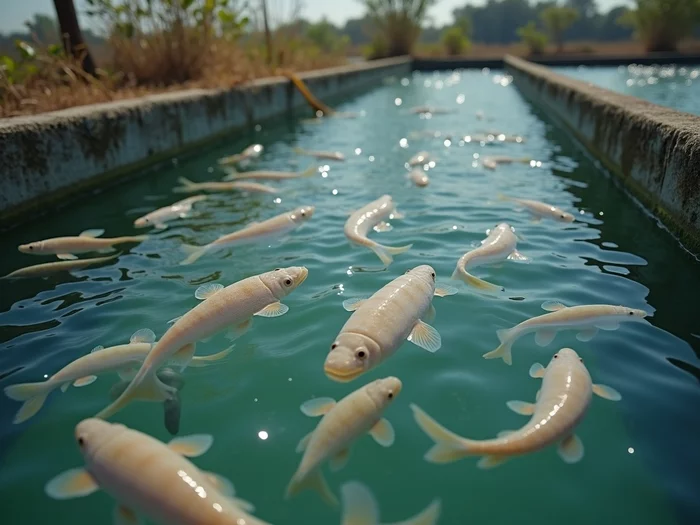
Mastering larval rearing isn't just about reducing losses—it's about building a sustainable foundation for your entire catfish enterprise. When you can consistently produce healthy, vigorous juveniles, you control your production costs, ensure steady supply for grow-out ponds, and create opportunities for selling fingerlings to other farmers. With African catfish demand growing across the continent and fingerling prices ranging from 8-25 naira each depending on size and location, successful larval rearing becomes your pathway to both food security and economic prosperity.
Feeding Techniques for African Catfish Larvae
Proper nutrition during the larval stage determines whether your young catfish will develop into robust juveniles or struggle with poor growth and high mortality. African catfish larvae have specific nutritional requirements that change as they develop, and your feeding strategy must adapt accordingly. The choice between live feeds and formulated diets, timing of transitions, and understanding developmental nutrition needs will make the difference between 30% survival and 85% survival in your hatchery.
Feeding Strategies: Live Feeds vs. Formulated Diets
Live feeds provide the gold standard for African catfish larval nutrition, particularly during the first 10-14 days after hatching. Artemia (brine shrimp) nauplii offer exceptional nutritional value with 60% protein content and essential fatty acids that boost larval development. You can purchase Artemia cysts from aquaculture suppliers in Lagos, Accra, or Nairobi for 2,500-3,500 naira per 500g tin, which will feed thousands of larvae.
Moina (water fleas) present a more cost-effective alternative that you can culture locally using poultry manure or rice bran in shallow earthen ponds. A farmer in Kano State maintains Moina cultures in 2m x 3m concrete tanks, harvesting 200-300g daily to feed 100,000 catfish larvae. Tubifex worms work well for larger larvae (7-10 days old) but require careful cleaning to prevent disease introduction.
Formulated diets offer convenience and consistent nutrition but require careful selection. Choose larval feeds with minimum 45% protein, particle sizes below 100 microns for newly hatched larvae, and high digestibility. Commercial larval feeds cost 800-1,200 naira per kilogram but provide reliable nutrition when live feeds aren't available. Studies from Egyptian catfish farms show that larvae fed exclusively on quality formulated diets can achieve 70-75% survival rates compared to 80-90% with live feeds.
| Feeding Type | Protein Content | Cost (per kg) | Survival Rate (%) |
|---|---|---|---|
| Live Feeds (e.g., Artemia) | 60% | 2,500-3,500 naira | 80-90% |
| Live Feeds (e.g., Moina) | 50-55% | Low (local culture) | 70-80% |
| Formulated Diets | 45-55% | 800-1,200 naira | 70-75% |
Transitioning to Formulated Diets
Begin the transition process when your larvae reach 7-10 days old and measure approximately 8-12mm in length. Start by mixing finely powdered formulated diet with live feeds at a 20:80 ratio during morning feedings while maintaining pure live feeds for evening meals. Over the next week, gradually increase the formulated diet proportion to 50:50, then 80:20, monitoring larval behaviour and survival closely throughout the process.
Feed frequency during transition requires careful attention—provide small amounts 6-8 times daily rather than large portions 3-4 times. African catfish larvae have limited stomach capacity and digest food rapidly in warm tropical conditions. A successful farmer in Kumasi feeds his transitioning larvae every 2-3 hours from 6 AM to 8 PM, adjusting quantities based on consumption within 15-20 minutes.
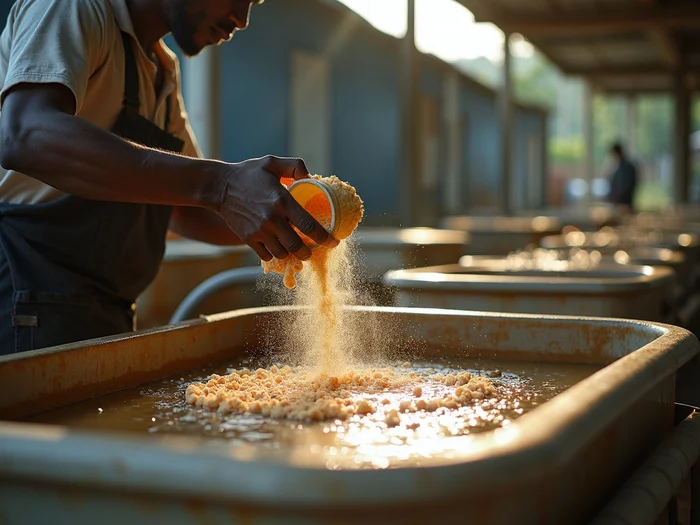
Complete the transition to formulated diets by day 14-18, when larvae measure 15-20mm and show strong swimming behaviour. At this stage, reduce feeding frequency to 4-5 times daily with particle sizes increasing to 200-400 microns. Monitor water quality closely during transition periods as uneaten formulated feeds decompose faster than live feeds, potentially causing ammonia spikes.
Nutritional Requirements for Different Larval Stages
Newly hatched African catfish larvae (0-3 days) rely entirely on their yolk sacs for nutrition and don't require external feeding. During this period, maintain water temperature at 26-28°C and ensure gentle water circulation without creating strong currents that exhaust the developing larvae. You'll notice the yolk sac shrinking and larvae becoming more active as they prepare for first feeding.
First feeding stage (4-10 days) demands the highest quality nutrition with 50-55% protein content and essential fatty acids for proper organ development. Artemia nauplii provide ideal nutrition during this critical period—feed 5-10 nauplii per larva, 6-8 times daily. Alternatively, use finely sieved Moina or high-quality larval powder at 8-12% of larval body weight daily, divided into multiple small feedings.
Juvenile transition stage (11-21 days) allows for dietary diversification as digestive systems mature. Protein requirements remain high at 45-50%, but larvae can now handle larger food particles and begin accepting formulated diets. Feed 6-8% of body weight daily, adjusting based on water temperature—increase feeding rates during warmer periods when metabolism accelerates, reduce during cooler weather to prevent water quality problems.
| Growth Stage | Age (Days) | Nutritional Needs | Feeding Frequency |
|---|---|---|---|
| Newly Hatched | 0-3 days | Yolk sac only | No feeding |
| First Feeding | 4-10 days | 50-55% protein | 6-8 times daily |
| Juvenile Transition | 11-21 days | 45-50% protein | 4-5 times daily |
Water Quality Management in Hatcheries
Water quality management forms the foundation of successful larval rearing, directly affecting survival rates, growth performance, and disease resistance in your African catfish hatchery. Poor water conditions can kill thousands of larvae within hours, while optimal parameters create an environment where larvae thrive and develop rapidly. Understanding the critical parameters, implementing effective aeration systems, and maintaining proper water exchange protocols will transform your hatchery from a high-risk operation into a reliable production system.
Key Parameters to Monitor
Temperature control requires your constant attention, as African catfish larvae are extremely sensitive to fluctuations. Maintain water temperature between 26-30°C throughout the larval period, with 28°C being optimal for maximum growth and survival. Install reliable thermometers in each tank and check readings at least twice daily—morning and evening. A farmer in Ibadan uses simple glass thermometers costing 500 naira each, checking every tank before feeding times.
pH levels must stay within 6.8-8.2 range, with 7.2-7.8 providing ideal conditions for larval development. Test pH daily using digital metres or colour indicator strips, adjusting gradually if readings fall outside acceptable ranges. Never make rapid pH changes—adjust maximum 0.2 units per day using agricultural lime to raise pH or organic acids to lower it. Sudden pH swings will stress larvae and increase mortality significantly.
Dissolved oxygen demands your most careful monitoring, as larvae require minimum 5mg/L for healthy development, with 6-8mg/L being optimal. Check oxygen levels early morning before sunrise when levels typically reach their lowest point. Install backup aeration systems to prevent catastrophic losses during power outages—a simple manual hand pump can save thousands of larvae during emergencies. For more in-depth information, consider our guide on managing dissolved oxygen.
Ammonia and nitrite toxicity poses serious threats to larval survival. Keep ammonia below 0.25ppm and nitrite below 0.1ppm through proper feeding management and regular water changes. Test these parameters every 2-3 days using commercial test kits available from aquaculture suppliers. High readings indicate overfeeding, inadequate water exchange, or insufficient biological filtration requiring immediate corrective action.
| Parameter | Optimal Range | Monitoring Frequency | Action if Out of Range |
|---|---|---|---|
| Temperature | 26-30°C | Twice daily | Adjust heating/cooling systems |
| pH | 6.8-8.2 | Daily | Gradual adjustment using lime/organic acids |
| Dissolved Oxygen | 5-8 mg/L | Daily | Increase aeration |
| Ammonia | <0.25 ppm | Every 2-3 days | Reduce feeding and increase water exchange |
| Nitrite | <0.1 ppm | Every 2-3 days | Improve biological filtration |
Aeration Techniques
Air stone systems provide the most cost-effective aeration for small-scale hatcheries. Install 2-3 air stones per square metre of tank bottom, connected to reliable air pumps capable of delivering 0.5-1.0 cubic metres of air per hour per thousand larvae. Position air stones to create gentle water circulation without creating strong currents that exhaust swimming larvae. A typical setup costs 15,000-25,000 naira for a 10 cubic metre hatchery system.
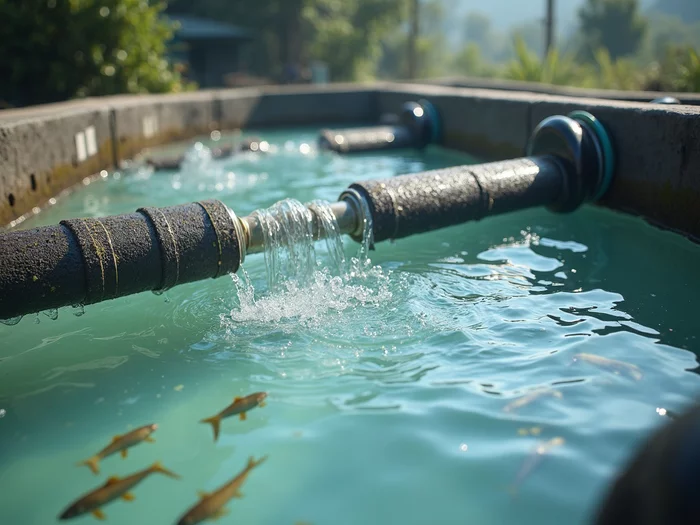
Paddle wheel aerators work excellently for larger hatchery operations with tanks exceeding 20 cubic metres. These systems provide both oxygen transfer and water circulation, maintaining uniform conditions throughout the tank. Install 0.5-1.0 horsepower paddle wheels for every 50-100 cubic metres of water volume, operating continuously during larval rearing periods. Consider solar-powered systems to reduce operational costs in areas with reliable sunshine.
Venturi systems offer energy-efficient aeration by using water pumps to draw air into the water flow. Install venturi valves on water return lines from filtration systems, creating fine bubble aeration without separate air pumps. This method works particularly well in recirculating systems where water pumps already operate continuously.
Emergency aeration preparations prevent disaster during power failures common across Africa. Maintain battery-powered air pumps, manual stirring paddles, and emergency generators for critical periods. A farmer in Kisumu keeps car batteries connected to small air pumps as backup systems, successfully maintaining his larvae during 8-hour power outages.
Water Exchange Protocols
Daily water exchanges of 10-20% help maintain optimal water quality while removing accumulated waste products and uneaten food. Perform exchanges during morning hours before feeding, using aged water that matches tank temperature within 2°C. Calculate exchange volumes precisely—for a 5,000-litre tank, remove 500-1,000 litres daily and replace with fresh, conditioned water.
Water conditioning before adding to larval tanks prevents shock and chemical burns. Age new water for 24-48 hours in separate tanks, allowing chlorine to dissipate and temperature to stabilise. Test pH and hardness of replacement water, adjusting if necessary to match existing tank conditions. Never add untreated borehole or municipal water directly to larval tanks.
Siphoning techniques allow gentle water removal without disturbing larvae or creating strong currents. Use 25-40mm diameter flexible tubing, starting siphon action slowly and maintaining steady flow rates. Begin siphoning from tank corners and work towards the centre, removing settled waste and debris along with old water. A good siphoning session removes waste while minimising larval stress.
Water replacement timing affects larval behaviour and feeding responses. Complete water exchanges before morning feeding when larvae are most active and adaptable to environmental changes. Avoid water changes during late evening or night hours when larvae are less active and more susceptible to stress. Monitor larval behaviour during and after water changes—healthy larvae should resume normal swimming patterns within 15-30 minutes.
Hatchery Setup for Successful Larval Rearing
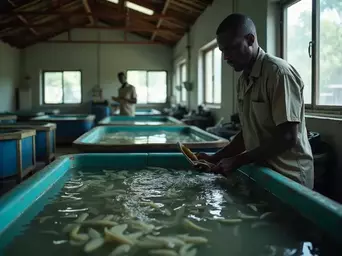
Proper hatchery design and hatchery setup create the controlled environment necessary for consistent larval production success. Your choice of systems, equipment selection, and facility layout directly impact survival rates, labour efficiency, and operational costs. Whether you're building a simple tank-based system or considering pond alternatives, understanding the fundamental requirements and management protocols will help you create a productive larval rearing operation suited to African conditions and resource availability.
Designing a Simple Hatchery
Tank dimensions should accommodate your production goals while allowing effective management and monitoring. Rectangular concrete tanks measuring 3m x 2m x 1m (6 cubic metres) provide excellent space for rearing 50,000-75,000 African catfish larvae with proper stocking densities. Build tanks with smooth interior surfaces to facilitate cleaning and prevent injury to delicate larvae. Include rounded corners rather than sharp angles where waste and debris can accumulate.
Construction materials must withstand tropical conditions while remaining cost-effective for small-scale farmers. Reinforced concrete blocks with waterproof cement render create durable, long-lasting tanks costing 150,000-250,000 naira for a 6-cubic-metre system. Alternatively, fibreglass tanks offer portability and easier installation at 80,000-150,000 naira each, though they require more careful handling and may have shorter lifespans under intense tropical sun.
Essential equipment includes reliable water pumps, aeration systems, heating elements for cooler periods, and basic water testing kits. Budget 100,000-200,000 naira for complete equipment setup including backup systems. Install drainage outlets 5-10cm above tank bottoms to facilitate partial water changes while maintaining minimum water levels. Include overflow pipes set at maximum water levels to prevent flooding during heavy rains.
Roofing and shelter protect your hatchery from direct sunlight and rainfall while allowing adequate ventilation. Simple galvanised iron sheets on steel framework cost 50,000-100,000 naira for a 50 square metre facility. Include side walls that can be opened or closed based on weather conditions, maintaining temperature control while preventing contamination from dust and debris during harmattan seasons.
Pond vs. Tank Systems
Tank systems offer superior control over water quality, feeding precision, and harvesting efficiency, making them ideal for intensive larval production. You can monitor and adjust conditions rapidly, perform selective harvesting, and maintain biosecurity more effectively. Tank systems typically achieve 75-90% survival rates when properly managed, though initial investment costs are higher at 200,000-400,000 naira per production unit.
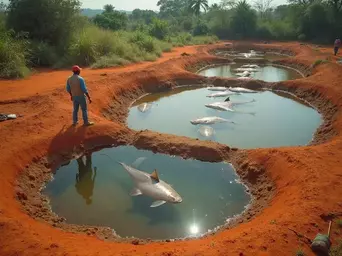
Pond systems provide lower initial investment and utilise natural biological processes for water quality maintenance. Earthen ponds measuring 10m x 15m x 1.5m cost 100,000-200,000 naira to construct and can rear 100,000-200,000 larvae per cycle. However, predation from birds, frogs, and insects increases mortality, while harvesting becomes more labour-intensive and less selective.
Climate considerations favour tank systems in areas with extreme weather variations or poor water sources. Tanks allow heating during cool periods and provide protection from heavy rains that can cause sudden pH and temperature changes in open ponds. In consistently warm regions with reliable water sources, pond systems may offer better cost-effectiveness for large-scale operations.
Management intensity differs significantly between systems. Tank systems require daily monitoring, frequent water changes, and precise feeding schedules but offer predictable results. Pond systems need less daily intervention but require careful preparation, natural food cultivation, and acceptance of higher mortality rates due to environmental factors beyond your direct control.
Management Protocols for Hatcheries
Daily inspection routines begin with visual assessment of larval behaviour, water clarity, and equipment function before dawn feeding times. Check for dead or weak larvae, unusual swimming patterns, or signs of disease outbreak. Count and remove mortalities, recording numbers for survival rate calculations. Observe feeding responses during morning meals—healthy larvae should show immediate interest and active feeding behaviour.
Water quality monitoring follows a strict schedule with temperature and dissolved oxygen checked twice daily, pH every morning, and ammonia/nitrite levels every 2-3 days. Record all measurements in logbooks, noting any significant changes or trends. A farmer in Ogun State discovered that his survival rates improved from 60% to 85% simply by maintaining detailed records and identifying subtle water quality patterns.
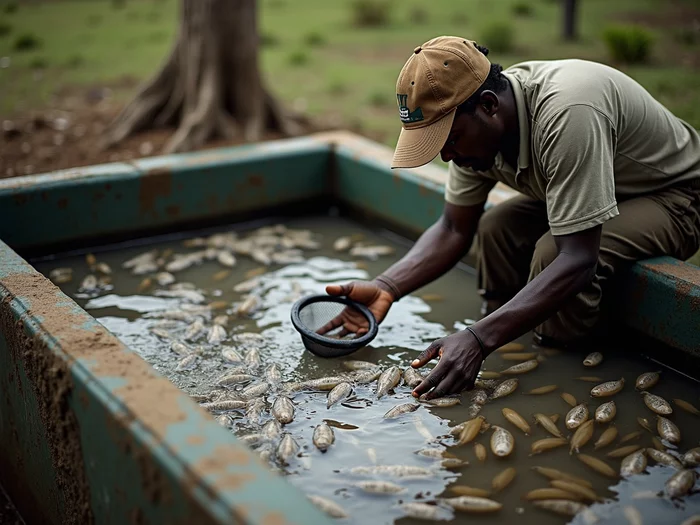
Feeding protocols require precise timing and quantity control. Feed larvae 6-8 times daily during first two weeks, reducing to 4-5 times as they grow larger. Calculate feeding amounts based on larval numbers and estimated weights, adjusting for temperature and observed consumption rates. Remove uneaten food within 30 minutes to prevent water quality deterioration.
Equipment maintenance includes daily cleaning of air stones, weekly inspection of pumps and filters, and monthly replacement of worn components. Keep spare parts inventory including air stones, tubing, and basic pump components to prevent production losses during equipment failures. A simple maintenance schedule prevents most equipment problems while ensuring consistent performance throughout the larval rearing period.
Survival Optimisation Techniques
Maximising larval survival requires attention to environmental factors, management practices, and preventive measures that address the primary causes of mortality in African catfish hatcheries. Beyond basic water quality and feeding, successful farmers implement specific techniques that create optimal conditions for larval development while minimising stress and disease risks. These survival optimisation strategies can increase your success rates from typical 40-60% survival to consistently achieving 80-90% or higher.
Providing Shelter for Larvae
Artificial shelter materials reduce stress and provide refuge areas that promote natural behaviour in African catfish larvae. Install fine-mesh nets, plastic sheeting, or aquatic plants covering 30-40% of tank surface area to create shaded zones where larvae can rest and avoid bright lighting. Simple plastic mesh costing 2,000-3,000 naira per 10 square metres provides effective shelter while allowing easy removal for tank cleaning.
Natural vegetation offers excellent shelter while contributing to water quality improvement through nutrient uptake. Water hyacinth, water lettuce, or local aquatic plants can be introduced in controlled quantities, covering no more than 25% of water surface to prevent oxygen depletion during night hours. A catfish farmer in Kaduna uses water hyacinth in corner sections of his larval tanks, reporting 15-20% improvement in survival rates compared to bare tanks.
Substrate materials on tank bottoms provide hiding places and reduce stress from constant swimming in open water. Fine sand, small gravel, or specialised aquaculture substrates create natural environments while supporting beneficial bacteria growth. Avoid materials that can trap food or create anaerobic zones—maintain substrate layers at 2-3cm maximum depth with regular cleaning to prevent waste accumulation.
Lighting control prevents stress from excessive illumination while maintaining necessary visibility for feeding and monitoring. Use diffused lighting or shade cloth to reduce light intensity to 50-70% of full sunlight during peak hours. Install timers for artificial lighting systems, providing 12-14 hours of moderate light daily with gradual transitions between light and dark periods rather than sudden changes.
Daily Cleaning and Maintenance
Waste removal protocols prevent accumulation of organic matter that degrades water quality and creates disease breeding conditions. Siphon tank bottoms daily before morning feeding, removing uneaten food, faecal matter, and dead larvae. Focus cleaning efforts on corners and low-flow areas where debris settles, using gentle suction to avoid disturbing healthy larvae.
Tank surface cleaning removes biofilm and floating debris that can harbour harmful bacteria and reduce gas exchange efficiency. Use clean cloths or soft brushes to wipe tank walls just above water level, removing algae buildup and organic deposits. Perform surface skimming with fine nets to collect floating particles and dead insects that may contaminate the water.
Equipment cleaning maintains optimal function and prevents bacterial contamination. Clean air stones weekly by soaking in dilute bleach solution (1:10 ratio) for 30 minutes, then rinsing thoroughly before reinstalling. Inspect and clean pump intakes, filter media, and water distribution systems every 3-5 days to maintain proper flow rates and water circulation.
Record keeping during cleaning activities helps identify patterns and potential problems before they become serious. Note quantities of waste removed, unusual odours, changes in water colour, or equipment performance issues. A farmer in Enugu discovered that increased waste production preceded disease outbreaks by 2-3 days, allowing him to implement preventive measures and avoid major losses.
Mortality Reduction Strategies
Disease prevention begins with strict biosecurity measures including footbaths, hand washing stations, and dedicated equipment for each tank system. Use potassium permanganate solutions (1:10,000 dilution) for footbaths and equipment disinfection between tanks. Never share nets, siphon tubes, or other equipment between different larval batches without proper disinfection procedures.
Stress minimisation reduces susceptibility to disease and improves overall survival rates. Maintain consistent water temperatures within 1-2°C variation, avoid sudden changes in lighting or feeding routines, and handle larvae gently during any necessary procedures. Reduce noise levels around hatchery areas and limit visitor access to prevent disturbances that can trigger stress responses.
Early intervention protocols address problems before they escalate into major mortality events. Increase water exchange rates at first signs of poor water quality, reduce feeding temporarily if waste accumulation increases, and isolate affected tanks immediately if disease symptoms appear. Quick response to early warning signs often prevents losses that could eliminate entire larval batches.
Nutritional support during stressful periods helps larvae maintain immune function and resist disease pressures. Supplement feeds with vitamin C (ascorbic acid) at 100-200mg per kilogram of feed during water quality problems or disease challenges. Probiotics added to water or feed at manufacturer-recommended rates can improve digestive health and disease resistance in stressed larvae.
Record-Keeping and Biosecurity Practices
Production records should track survival rates, growth performance, water quality parameters, feeding amounts, and mortality patterns for each larval batch. Maintain daily logbooks recording temperature, pH, dissolved oxygen, feeding times and amounts, observed behaviour, and any unusual events. Calculate weekly survival rates and compare between different management practices to identify most effective techniques.

Health monitoring includes daily observation for disease symptoms such as erratic swimming, loss of appetite, unusual colouration, or visible lesions. Document any health issues with dates, affected numbers, symptoms observed, and treatments applied. Photograph unusual conditions when possible to aid in diagnosis and future reference.
Biosecurity protocols prevent introduction and spread of pathogens between production units. Establish quarantine procedures for new equipment or materials, disinfect all items entering the hatchery area, and maintain separate equipment sets for each production cycle. Restrict access to essential personnel only and require protective clothing and footwear for all hatchery work.
Data analysis helps identify successful management practices and areas needing improvement. Review monthly survival rates, growth performance, and feed conversion ratios to evaluate hatchery efficiency. Compare results between different feeding strategies, water management protocols, and environmental conditions to optimise your production system continuously.
Conclusion
Successful African catfish larval rearing comes down to mastering four critical areas: precise feeding schedules with high-quality nutrition, maintaining optimal water conditions through daily monitoring, creating proper hatchery environments with adequate shelter, and implementing strict biosecurity measures. Start with live feeds like Artemia or Moina for your first 10-14 days, maintain water temperature at 26-30°C with dissolved oxygen above 5mg/L, and perform daily water exchanges of 10-20% to keep your larvae thriving. Remember that feeding 6-8 times daily during early stages and providing gentle aeration will dramatically improve your survival rates.
You now have the technical knowledge that successful farmers across Nigeria, Ghana, and Kenya use to achieve 80-90% survival rates consistently. Yes, larval rearing requires attention to detail and daily commitment, but thousands of farmers have mastered these techniques starting from exactly where you are now. Each batch you rear will teach you something new about reading larval behaviour, adjusting feeding amounts, and spotting potential problems before they become disasters.
With reliable larval production as your foundation, you can now focus on optimising your grow-out systems and developing markets for your fingerlings. Consider exploring advanced nutrition strategies, expanding your hatchery capacity, or investigating value-added processing opportunities. Strong larval rearing skills give you control over your entire production chain—from egg to market-sized fish. Your journey toward sustainable catfish farming success has a solid technical foundation.
Frequently Asked Questions
What is the best way to start feeding newly hatched African catfish larvae?
For the first 10-14 days after hatching, live feeds are the "gold standard" for nutrition. You should primarily use Artemia nauplii, feeding 5-10 nauplii per larva, 6-8 times daily, as they offer high protein and essential fatty acids. Alternatively, finely sieved Moina or high-quality larval powder can be used.
How can I tell if my African catfish larvae are healthy and feeding well?
Healthy larvae will show immediate interest and active feeding behaviour during meal times. You should also observe strong swimming behaviour by day 14-18, and they should be growing consistently. Conversely, weak larvae, slow growth, or unusual swimming patterns indicate potential problems with feeding or water quality.
Why is it so important to maintain consistent water temperature for African catfish larvae?
African catfish larvae are extremely sensitive to temperature fluctuations, and maintaining 26-30°C (with 28°C being optimal) is crucial for their growth and survival. Consistent temperatures prevent stress, which can lead to increased mortality and susceptibility to disease. Install reliable thermometers and check them at least twice daily.
Can I use formulated diets exclusively for African catfish larvae, or do I need live feeds?
While quality formulated diets can achieve 70-75% survival rates, live feeds like Artemia or Moina offer superior nutritional value, leading to 80-90% survival. It's best to start with live feeds for the first 7-10 days, then gradually transition to formulated diets by mixing them in, increasing the proportion over a week.
How do I prevent waste accumulation in my hatchery tanks, especially during feeding?
To prevent waste accumulation, siphon tank bottoms daily before morning feeding, focusing on corners and low-flow areas to remove uneaten food, faecal matter, and dead larvae. Additionally, ensure you feed small amounts 6-8 times daily and remove any uneaten food within 30 minutes, as formulated feeds decompose faster.


Yomi Adisa Lead Researcher
Yomi Adisa is the lead researcher at Fish Farming Business, where he studies what makes aquaculture ventures profitable across Africa. His research focuses on market patterns, buyer preferences, and the business decisions that determine success or failure in fish farming.