How to Set Up a Catfish Hatchery: Essential Equipment and Water Management
Posted on: 2025-10-03
By: Yomi Adisa
How to Set Up a Catfish Hatchery: Essential Equipment and Water Management
You've watched other farmers produce thousands of healthy fingerlings whilst your own hatchery struggles with poor hatching rates, frequent disease outbreaks, and inconsistent production. Every failed batch represents lost time, wasted resources, and mounting frustration as you wonder what you're doing wrong. The problem isn't your dedication—it's that setting up a successful catfish hatchery requires specific technical knowledge that most farmers never receive.
📑 Table of Contents
A properly designed hatchery with correct equipment and water management can produce over 80% hatching rates consistently, whilst poor setups struggle to achieve 40% success. This difference determines whether your hatchery becomes a profitable foundation for your farming operation or an expensive source of problems. Without understanding essential equipment specifications, water quality parameters, and breeding protocols, you're essentially gambling with expensive broodstock and hoping for good results.
Many farmers attempt hatchery operations using inadequate equipment or inappropriate techniques, leading to devastating losses during critical breeding seasons. The infrastructure decisions you make today will affect your production capacity and success rates for years to come. Proper water management alone can prevent 70-80% of common hatchery problems, whilst incorrect systems create ongoing challenges that drain both time and money.
This comprehensive guide provides complete technical specifications for establishing and operating a successful catfish hatchery. You'll learn exact equipment requirements, detailed water management techniques, broodstock handling protocols, and troubleshooting solutions for common problems. By following these proven methods, you'll build a hatchery system that produces healthy fingerlings consistently, giving your catfish farming operation the strong foundation it needs to succeed.
🎯 What You'll Learn
- Understand the critical specifications for setting up flow-through and recirculating aquaculture systems to enhance hatchery efficiency
- Master essential water management techniques and equipment to maintain optimal water quality for healthy catfish development
- Discover effective biosecurity measures to prevent disease outbreaks in your hatchery and protect your investment
Picture this: You walk into your catfish hatchery on a crisp morning, and thousands of healthy fingerlings swim vigorously in crystal-clear water. Your incubation tanks are producing consistent hatching rates of over 80%, your broodstock are in prime breeding condition, and your water quality parameters remain stable day after day. This isn't just a dream – it's the reality for farmers who understand proper hatchery setup and management.

Setting up a successful catfish hatchery requires more than just tanks and water. You need comprehensive knowledge of infrastructure design, essential equipment specifications, water management techniques, and broodstock handling protocols that work reliably in African conditions. Whether you're planning your first hatchery or upgrading an existing facility, understanding these technical fundamentals will determine your success.
This guide provides you with complete technical knowledge for establishing and operating a catfish hatchery, focusing on essential equipment and effective water management practices. You'll learn exact specifications for hatchery systems, detailed equipment requirements, water quality parameters, breeding protocols, and troubleshooting solutions. This production knowledge matters because hatchery operations form the foundation of successful catfish farming – poor quality fingerlings will never produce profitable fish, regardless of how well you manage grow-out ponds.
Understanding Hatchery Infrastructure
Types of Hatchery Systems
Your choice of hatchery system fundamentally affects your production capacity, operational costs, and success rates. Two primary systems dominate catfish hatchery operations: flow-through systems and recirculating aquaculture systems (RAS). Flow-through systems use a continuous supply of fresh water that enters tanks, supports fish life, then exits the system.
These systems work exceptionally well when you have access to reliable, clean water sources like boreholes or streams. The major benefit is simplicity – fewer mechanical components mean less maintenance and lower risk of system failure. Water quality remains consistently high because fresh water constantly dilutes waste products.
However, flow-through systems require substantial water volumes. A typical 1,000-litre hatchery tank needs 2-4 litres per minute of continuous flow, meaning you'll use 2,880-5,760 litres daily per tank. Recirculating aquaculture systems filter and reuse water continuously, making them ideal for areas with limited water access or high water costs.
RAS systems can operate effectively using only 5-10% of the water volume required by flow-through systems. You maintain water quality through biological filtration, mechanical filtration, and oxygenation rather than water exchange. The challenge lies in system complexity – you need reliable pumps, filters, aerators, and backup power systems.
| System Type | Advantages | Disadvantages | Water Usage |
|---|---|---|---|
| Flow-through System | Simplicity, low maintenance | High water usage | 2,880-5,760 litres daily per 1,000-litre tank |
| Recirculating Aquaculture System (RAS) | Water conservation, control of water quality | Complexity, equipment failure risks | Only 5-10% of flow-through water volume |
Essential Hatchery Layout Considerations
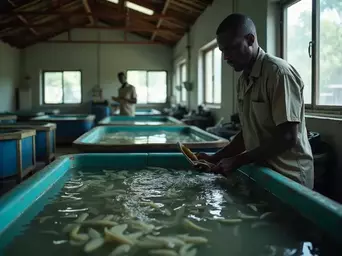
Effective hatchery design starts with understanding water flow patterns and operational workflows. Your layout should follow a logical progression from broodstock holding through egg incubation to fingerling production, minimising cross-contamination risks and labour requirements. Allocate approximately 40% of your space to production tanks, 25% to filtration and water treatment equipment, 20% to walkways and working areas, and 15% to storage and office space.
For a basic 100 square metre hatchery, this translates to 40 square metres of tank space, accommodating 8-12 tanks of 500-1,000 litres each. Tank dimensions should allow easy access for cleaning and fish handling – rectangular tanks of 2 metres by 1 metre by 0.5 metres deep work well for most operations. Water flow design requires careful planning.

In flow-through systems, position your water inlet at the highest point, allowing gravity to move water through successive treatment and holding tanks before discharge. Install valves every 10-15 metres to isolate sections during maintenance. For RAS systems, design your filtration loop to turn over total system volume 4-6 times hourly, ensuring adequate waste removal and oxygenation.
Working areas need sufficient space for daily operations. Allow 1.5-2 metres between tank rows for comfortable access with wheelbarrows and equipment. Install adequate lighting – minimum 200 lux at water surface level for detailed fish observation and 400 lux in working areas for precise tasks like egg counting and grading.
Biosecurity Measures in Hatchery Design
Biosecurity prevents disease introduction and spread within your hatchery, protecting your investment and ensuring consistent production. Design your facility with distinct zones that control access and limit contamination pathways. Create a clean zone containing your incubation and early rearing tanks, accessible only through a disinfection footbath and hand-washing station.
This zone should have independent water supply and drainage systems to prevent contamination from other areas. Position your broodstock holding tanks in a separate zone with controlled access, as mature fish carry higher disease risks than eggs and fry. Install physical barriers between zones using concrete walls or plastic sheeting.
These barriers prevent airborne contamination and force personnel to follow proper disinfection protocols when moving between areas. Design drainage systems to prevent backflow – waste water from fingerling tanks should never flow toward incubation areas. Implement quarantine facilities for new broodstock and equipment.
Essential Equipment and Water Management Techniques
Water Management Equipment
Your water management system forms the heart of hatchery operations, requiring specific equipment sized appropriately for your production goals. Start with water pumps capable of moving your required flow rates reliably under local power conditions. For flow-through systems, calculate pump requirements based on tank volumes and desired turnover rates.
A 1,000-litre tank requiring 4 turnovers daily needs 4,000 litres pumped over 24 hours, or approximately 167 litres per hour. Add 50% capacity margin for pump wear and system resistance, giving you a minimum requirement of 250 litres per hour per tank. Centrifugal pumps work well for these applications – a 0.5 horsepower pump typically delivers 300-500 litres per hour at moderate head pressure.
Submersible pumps offer advantages in African conditions where power fluctuations are common. They're less susceptible to priming problems and continue operating during brief power interruptions. Position pumps in sump tanks or wells to ensure continuous water supply even during low water periods.
Aeration equipment maintains dissolved oxygen levels essential for fish survival and growth. Venturi aerators work effectively in flow-through systems, using water flow to draw air into the stream. Install one venturi aerator per 500 litres of tank volume for adequate oxygenation.
Electric aerators provide more precise oxygen control in RAS systems. Diffuser stones connected to air pumps create fine bubbles that maximise oxygen transfer efficiency. Size your air pump to deliver 2-4 litres of air per minute per 100 litres of water volume.
Filtration systems remove waste products that accumulate in recirculating systems. Mechanical filters capture solid waste particles, whilst biological filters convert toxic ammonia to less harmful compounds. Install mechanical filtration before biological filtration to prevent solid waste from clogging biological media.
| Equipment Type | Purpose | Recommended Specifications | Cost Range |
|---|---|---|---|
| Water Pumps | Moving water | Flow rate of 250 litres/hour per tank | ₦15,000 - ₦30,000 |
| Aeration Equipment | Maintaining oxygen levels | Air flow rate of 20-40 litres/minute per 1,000 litres | ₦10,000 - ₦25,000 |
| Filtration Systems | Waste removal | Handle 150-200% of system flow rate | ₦20,000 - ₦50,000 |
| Monitoring Equipment | Water quality testing | Digital metres for DO, pH, temperature | ₦15,000 - ₦25,000 |
Incubation and Hatching Equipment
Successful catfish reproduction requires specialised equipment for egg incubation and fry hatching. Jar incubators work effectively for catfish eggs, providing gentle water circulation that prevents fungal growth whilst maintaining optimal oxygen levels. Standard incubation jars hold 2-4 litres and accommodate 50,000-100,000 fertilised eggs.
Water enters the bottom of each jar at 2-4 litres per minute flow rate, creating gentle upward circulation that keeps eggs suspended and oxygenated. Install flow control valves on each jar to adjust circulation based on egg development stage – newly fertilised eggs need gentler flow than developing embryos. Hatching troughs receive eggs from incubation jars 24-48 hours before hatching begins.
These shallow rectangular containers allow easy observation and cleaning whilst providing adequate space for newly hatched fry. Size your hatching troughs at 100-200 litres capacity per 50,000 eggs, with water depth maintained at 15-20 centimetres. Install fine mesh screens over trough outlets to prevent fry escape whilst allowing waste removal.

Temperature control equipment maintains optimal conditions throughout incubation and hatching. Catfish eggs develop best at 26-28°C, requiring heating systems in most African locations during cool seasons. Submersible aquarium heaters work well for small-scale operations – install 1 watt heating capacity per 4 litres of water volume for adequate temperature control.
Monitoring and Testing Equipment
Accurate water quality monitoring prevents problems before they become catastrophic, requiring reliable testing equipment suitable for daily use. Digital metres provide instant readings and eliminate colour interpretation errors common with test strips. Dissolved oxygen metres are essential for hatchery operations.
Catfish eggs and fry require minimum 5 milligrams per litre dissolved oxygen for healthy development. Digital DO metres cost 15,000-25,000 naira but provide accurate readings and long-term reliability. Calibrate your metre weekly using air-saturated water at known temperature.
pH metres monitor water acidity levels that affect fish health and biological filter performance. Maintain pH between 6.5-8.5 for optimal catfish reproduction. Digital pH metres require monthly calibration using buffer solutions but provide precise measurements essential for troubleshooting water quality problems.
Ammonia test kits detect toxic waste products that accumulate in recirculating systems. Total ammonia should remain below 0.5 milligrams per litre in hatchery systems. Liquid reagent test kits provide adequate accuracy for routine monitoring and cost significantly less than digital metres.
Water Quality Parameters and Techniques
Maintaining optimal water quality requires understanding specific parameters that affect catfish reproduction and survival. Each parameter interacts with others, creating complex relationships that determine overall system health. Temperature affects all biological processes in your hatchery.
Maintain 26-28°C for egg incubation, 28-30°C for fry rearing, and 24-26°C for broodstock holding. Temperature fluctuations stress fish and reduce reproduction success. Install backup heating systems to prevent temperature crashes during power outages.
Dissolved oxygen levels determine fish survival and growth rates. Maintain minimum 5 milligrams per litre for eggs and fry, 6-8 milligrams per litre for optimal growth. Oxygen levels decrease as temperature increases and as fish density increases.
pH affects fish physiology and biological filter performance. Maintain 7.0-8.0 for optimal conditions. pH naturally decreases in recirculating systems as biological filters convert ammonia to nitric acid. Add calcium carbonate or sodium bicarbonate to buffer pH when levels drop below 6.8.
| Parameter | Optimal Range | Monitoring Frequency | Effects of Deviations |
|---|---|---|---|
| Temperature | 26-28°C for incubation | Twice daily | Stress, reduced reproduction |
| Dissolved Oxygen | Minimum 5 mg/L for eggs | Daily | Increased mortality |
| pH | 6.5-8.5 | Weekly | Physiological stress |
| Ammonia | Below 0.5 mg/L | Daily | Toxicity |
Broodstock Management and Breeding Protocols
Selecting Quality Broodstock
Your breeding success depends entirely on broodstock quality, making selection criteria critical for long-term hatchery profitability. Quality broodstock produce more eggs, higher fertilisation rates, and healthier offspring that grow faster and survive better during grow-out. Select female broodstock weighing 1.5-3.0 kilograms with plump, rounded abdomens indicating good egg development.
Examine fish carefully for external parasites, wounds, or deformities that indicate poor health or genetic problems. Healthy females show bright, clear eyes, intact fins, and active swimming behaviour when disturbed. Male broodstock should weigh 1.0-2.0 kilograms with well-developed genital papillae indicating sexual maturity.
Males in breeding condition develop enlarged heads and darker colouration during spawning season. Test males for sperm quality by gently pressing the abdomen – healthy males release thick, white milt that remains active for 30-60 seconds in water. Maintain genetic diversity by sourcing broodstock from multiple suppliers and avoiding related fish.

Age affects breeding performance significantly. Female catfish reach peak reproduction at 3-5 years old, producing maximum egg numbers with highest fertilisation rates. Males remain productive longer, maintaining good sperm quality until 6-8 years old.
Hormone Induction and Egg Stripping
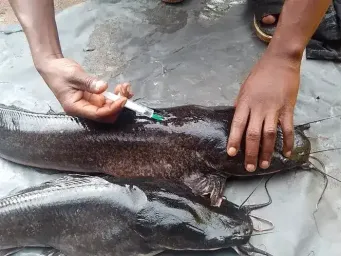
Catfish require hormone injection to trigger final egg maturation and ovulation in hatchery conditions. Human chorionic gonadotropin (HCG) works reliably for catfish breeding, available from veterinary suppliers in major cities. Calculate hormone dosage based on female body weight – inject 500-1,000 International Units HCG per kilogram body weight.
A 2-kilogram female receives 1,000-2,000 IU total dose. Divide the dose into two injections: give 25% of total dose initially, followed by 75% of dose 12 hours later. This protocol ensures proper hormone absorption and egg maturation timing.
Prepare injection solutions using sterile saline or distilled water. Dissolve hormone powder completely before drawing into syringes. Use 21-gauge needles for injection and handle fish gently to minimise stress.
Monitor injected females for ovulation readiness 10-14 hours after final injection. Gently press the abdomen – females ready for stripping release eggs easily with light pressure. Eggs should flow freely and appear golden-yellow in colour.
Monitoring Breeding Success and Record Keeping
Accurate record keeping tracks breeding performance and identifies successful broodstock for future use. Monitor key indicators that determine overall reproductive success and guide management decisions. Calculate fertilisation rates by examining eggs 6-8 hours after fertilisation.
Fertile eggs appear clear with visible cell division, whilst unfertile eggs turn white and opaque. Count 100-200 eggs from each batch to estimate fertilisation percentage. Successful breeding operations achieve 70-85% fertilisation rates consistently.
Track hatching rates by counting newly hatched fry and comparing to estimated egg numbers. Healthy eggs hatch 24-36 hours after fertilisation at 26-28°C. Hatching success should exceed 80% of fertilised eggs under proper incubation conditions.
Common Challenges and Troubleshooting
Disease Management in Hatcheries
Disease outbreaks can devastate hatchery operations within days, making prevention and early detection critical for success. Understanding common diseases and their management helps protect your investment and maintain consistent production. Fungal infections affect eggs and newly hatched fry most commonly, appearing as white, cotton-like growths on egg surfaces.
Saprolegnia and other water moulds thrive in poor water quality conditions with high organic matter levels. Prevent fungal problems by maintaining excellent water quality, removing dead eggs promptly, and ensuring adequate water circulation in incubation systems. Treat fungal infections using malachite green solutions at 2-5 milligrams per litre for 30-60 minutes daily.
Bacterial infections cause high mortality in fry and fingerlings, often triggered by stress, poor water quality, or overcrowding. Affected fish show lethargy, loss of appetite, and external lesions. Common bacterial pathogens include Aeromonas and Pseudomonas species that proliferate in warm, nutrient-rich water.
Parasitic infections affect fish of all ages but cause severe problems in crowded hatchery conditions. External parasites like Trichodina and Ichthyophthirius cause skin irritation, increased mucus production, and secondary bacterial infections. Control external parasites using salt baths at 10-15 grams per litre for 15-30 minutes, or formalin treatments at 15-25 milligrams per litre for 12-24 hours.
| Disease | Symptoms | Treatment | Prevention |
|---|---|---|---|
| Fungal Infections | White cotton-like growths | Malachite green treatment | Maintaining water quality |
| Bacterial Infections | Lethargy, lesions | Antibiotics treatment | Optimal stocking densities |
| Parasitic Infections | Skin irritation | Salt baths | Quarantine new fish |
Water Quality Failures
Water quality problems develop rapidly in intensive hatchery systems, requiring immediate recognition and corrective action to prevent fish losses. Understanding common failure patterns helps you respond effectively during emergencies. Oxygen depletion occurs suddenly during power outages, equipment failures, or algae die-offs.

Fish show gasping behaviour at water surface, reduced activity, and increased mortality if conditions persist. Install backup aeration systems using battery-powered air pumps or emergency generators to maintain oxygen levels during power interruptions. Respond to oxygen emergencies by increasing aeration immediately, reducing feeding rates, and lowering water temperature if possible.
Ammonia spikes develop when biological filters fail or systems become overloaded with organic waste. Fish show gill damage, lethargy, and increased susceptibility to diseases when ammonia exceeds safe levels. Test water immediately when fish behaviour changes and implement corrective measures rapidly.
pH crashes occur in soft water areas or when biological filters produce excess acids. Fish become stressed, biological filters stop functioning, and system collapse can occur within hours. Monitor pH levels regularly and maintain adequate alkalinity to buffer against sudden changes.
Setting up a successful catfish hatchery requires careful attention to infrastructure design, essential equipment selection, and rigorous water quality management. By focusing on proper tank sizing, reliable aeration systems, effective filtration, and consistent monitoring protocols, you create the foundation for producing healthy, vigorous fingerlings. Remember that your hatchery's success directly impacts every stage of your catfish farming operation—quality fingerlings grow faster, survive better, and ultimately generate higher profits.
Start with a well-designed layout that prioritises biosecurity and operational efficiency. Invest in reliable water management equipment sized appropriately for your production goals, and establish daily monitoring routines for critical parameters like dissolved oxygen, temperature, and ammonia levels. Don't attempt to build everything at once; begin with basic systems and expand gradually as your experience and confidence grow.
Your understanding of broodstock management, hormone induction protocols, and disease prevention strategies positions you to achieve the 70-85% fertilisation rates and 80%+ hatching success that define profitable operations. These technical skills take time to master, but you now have the roadmap for getting there. As your hatchery operations become more efficient, focus on developing grow-out pond management techniques and market strategies.
Frequently Asked Questions
What are the key differences between flow-through and RAS hatchery systems, and which is better for a new farmer in Africa?
Flow-through systems use continuous fresh water, offering simplicity and consistent water quality with fewer mechanical parts, ideal if you have abundant clean water. Recirculating Aquaculture Systems (RAS) filter and reuse water, saving up to 95% of water but requiring complex equipment and reliable power. For a new farmer, a flow-through system is often simpler to manage initially, reducing the risk of catastrophic equipment failure.
How can I ensure proper oxygen levels in my hatchery, especially during power outages?
For flow-through systems, venturi aerators are excellent as they use water flow and require no electricity, ideal for African conditions. In RAS, use diffuser stones with an appropriately sized air pump, ensuring you have a backup power system like a generator or battery-powered air pumps for emergencies to prevent sudden oxygen depletion.
Why is biosecurity so important in hatchery design, and what specific steps should I take?
Biosecurity prevents disease outbreaks that can quickly wipe out your hatchery stock. You should design distinct zones with controlled access, using footbaths and hand-washing stations, and separate water supply/drainage for clean areas. Also, implement a quarantine facility for new broodstock and equipment to observe them for 2-3 weeks before integration.
How do I know when my female catfish are ready for hormone injection, and what's the correct dosage?
Select females weighing 1.5-3.0 kg with plump, rounded abdomens and active swimming behaviour. For hormone induction, inject 500-1,000 International Units (IU) of HCG per kilogram of body weight, typically splitting the dose into 25% initially and the remaining 75% 12 hours later.
What are the most critical water quality parameters I need to monitor daily in my catfish hatchery?
You must monitor temperature, dissolved oxygen (DO), and pH daily, as these directly impact egg development and fry survival. Temperature should be 26-28°C for incubation, DO minimum 5 mg/L, and pH between 7.0-8.0. Additionally, check ammonia levels daily in new systems or weekly in established ones to prevent toxicity.


Yomi Adisa Lead Researcher
Yomi Adisa is the lead researcher at Fish Farming Business, where he studies what makes aquaculture ventures profitable across Africa. His research focuses on market patterns, buyer preferences, and the business decisions that determine success or failure in fish farming.